

Chemical Printing and Dyeing Membrane Filter Press Manufacturer Delivering High-Performance Filtration Systems
2026-08-29
In chemical printing and dyeing, every batch carries a hidden cost: sludge, fines, and aggressive wash water that can choke a lesser filter press in weeks. Yet most plants still settle for generic equipment that underperforms, leaks, and demands constant maintenance. Sinou took a different route. As a manufacturer focused solely on high-performance membrane filter presses for this punishing industry, Sinou engineers every plate, diaphragm, and hydraulic system to handle the heat, pH swings, and abrasive solids that define dyehouse effluent. The result is drier cakes, clearer filtrate, and cycles that don't stall. In the sections ahead, we break down the design choices that make Sinou's filtration systems stand out—not as another vendor claim, but as measurable uptime and lower operating cost. If your current press is costing you more than it recovers, keep reading.
Dewatering High-Pigment Sludge Without Membrane Clogging
High-pigment sludge presents a double challenge: the solids are both fine and highly adhesive, which means traditional membrane filtration quickly forms a dense, low-permeability cake. Instead of relying on standard backwashing, a more effective approach is to modify the feed itself through selective flocculation. By using a low-dose, high-molecular-weight cationic polymer that binds preferentially to pigment particles rather than to free water, floc size increases enough to create a more open filter cake while leaving the membrane surface less prone to pore plugging. This shifts the bottleneck from membrane fouling to cake compressibility, which can be managed mechanically.
A second lever is applying intermittent pressure relaxation rather than continuous high pressure during the filtration cycle. Short, controlled drops in transmembrane pressure allow the cake layer to expand slightly and release trapped fines before they become irreversibly embedded in the membrane pores. In parallel, using a coarse pre-coat or a thin nonwoven spacer directly on the membrane can prevent the finest pigment particles from ever reaching the active layer. This combination has been shown to extend cycle times by two to three times in pilot trials with iron oxide and titanium dioxide sludges.
For recalcitrant cases, electro-osmotic assistance can move water away from the membrane surface without increasing hydraulic pressure. A low-voltage direct current applied across the sludge bed drives water toward the cathode, effectively dewatering the cake while keeping the membrane itself under minimal hydraulic load. The key is to avoid excessive current density, which can cause ohmic heating and change pigment surface charge. When paired with periodic chemical cleaning using chelating agents that dissolve pigment-polymer complexes rather than conventional hypochlorite, this method sustains flux rates above 80 LMH for weeks without irreversible clogging.
Why Membrane Plate Alignment Matters for Leak-Free Operation
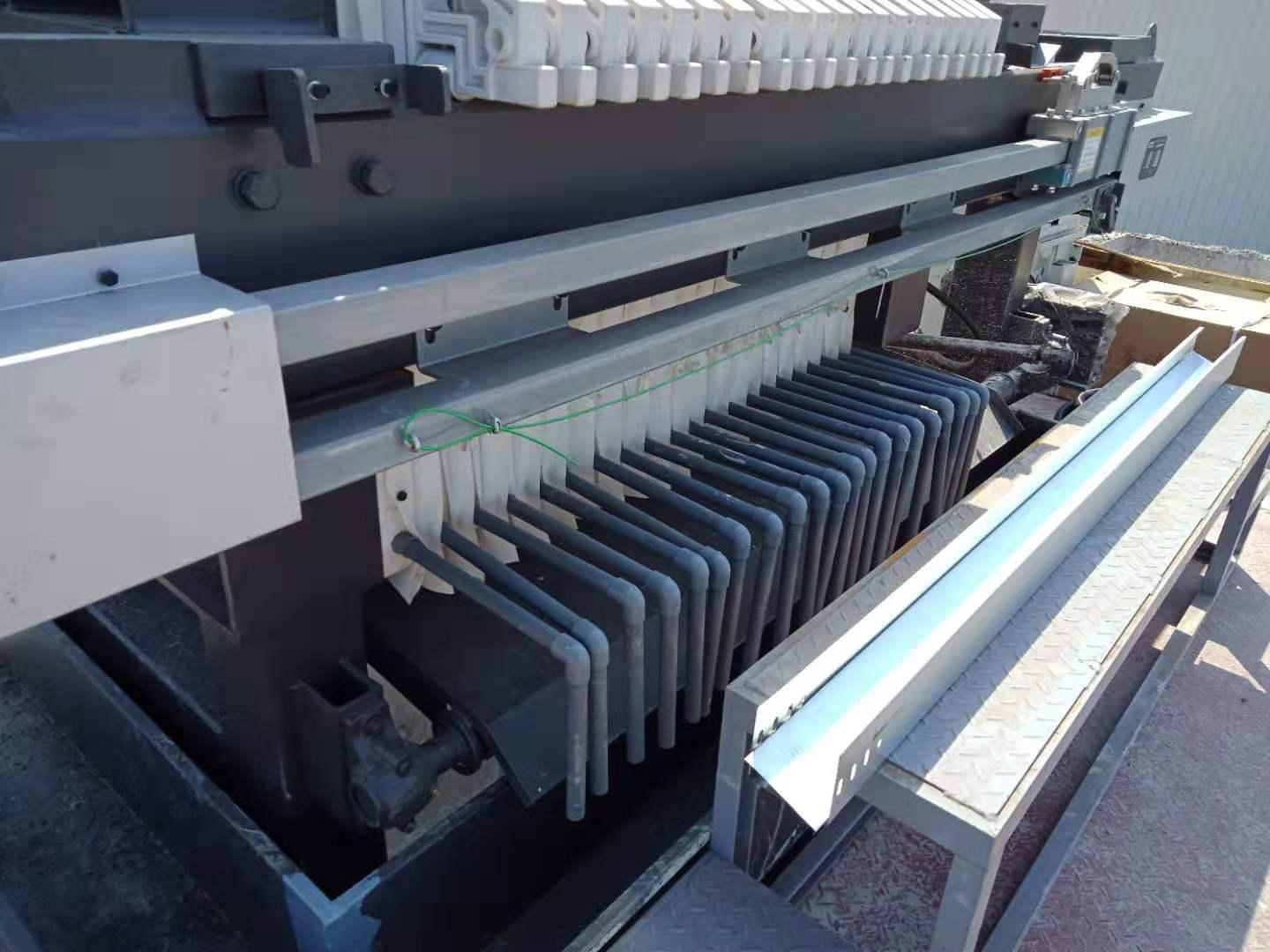
In membrane plate systems, alignment is more than just neat assembly. Every plate has sealing surfaces, feed ports, and filtrate channels that must line up exactly. Even a slight offset creates uneven pressure distribution along the gasket or membrane. That uneven load allows liquid to find a path between plates, which is where leaks typically start. Once a small leak develops, it can erode the sealing face and turn into a persistent problem.
Misalignment also affects how the membrane itself flexes during the squeeze cycle. If the plates are not parallel, the membrane inflates more on one side and less on the other. This reduces cake dryness, wastes feed pressure, and puts localized stress on the membrane edges. Over time, that repeated uneven flexing can cause the membrane to crack or delaminate at the plate boundary—leading to cross-contamination or sudden failure.
Good alignment comes down to consistent plate dimensions, proper rail or guide bar adjustment, and careful hydraulic closing pressure. Operators should check for plate drift after every few cycles, especially if the press has been moved or if a plate has been replaced. Taking the time to true up the stack before applying full pressure is far cheaper than dealing with persistent dripping, membrane replacement, or unscheduled downtime.
Adjusting Squeeze Pressure to Match Different Dye Types
Getting the right squeeze pressure isn’t a one-size-fits-all setting, and it becomes especially obvious when you switch between dye families. Reactive dyes, for instance, soak into the fiber rather than sitting on top, so a lighter, more even stroke works better—too much force can push dye past the intended print area and muddy the edges. Pigment-based systems, on the other hand, sit closer to the surface and tolerate a firmer pass, but even then you have to watch for buildup on the back of the screen.
Thickened or high-viscosity dye pastes need a bit more downward force just to clear the mesh, yet cranking up the pressure too far creates its own problems, like smearing or forcing dye into areas that should stay blank. Instead of thinking in terms of harder versus softer, it helps to adjust pressure in small increments and check the print side after each pull. What you’re looking for is a clean deposit with no excess paste left in the screen and no halo around the printed edge.
When you move from natural fabrics to synthetics, the pressure conversation changes again. Synthetics don’t absorb dye the same way cotton does, so a forceful stroke may cause dye to pool on the surface rather than penetrate. Lowering the pressure slightly and letting the squeegee angle do more of the work gives you a sharper result with less waste. Keeping a log of what works for each dye type and fabric blend saves a lot of trial and error later.
Reducing Residual Moisture for Easier Sludge Handling
Sludge that leaves a dewatering system still carrying excess water quickly turns routine handling into a slow, costly struggle. Conveyors clog, storage bins bridge, and transport weights climb with every percentage point of residual moisture left behind. The practical goal isn't just hitting a dry-solids number on a lab report—it's producing a cake that crumbles instead of smears, flows instead of sticking, and loads without spilling or extra passes from a front-end loader. Even a two or three percent reduction in moisture can mean the difference between a sludge that piles neatly and one that needs constant manual intervention.
Operators who chase lower residual moisture often discover that small adjustments to polymer dosing, mixing energy, and belt or centrifuge settings yield outsized improvements in cake structure. Overdosing polymer, for instance, can trap water inside flocs instead of releasing it, leaving a deceptively firm surface that still oozes under pressure. Underdosing, by contrast, lets fine particles blind the filter media and slow drainage. The sweet spot is found through jar testing and real-time observation of the cake's feel, not by trusting a single setpoint. Where possible, switching from a low-pressure to a high-pressure dewatering stage—or adding a secondary compression zone—removes water that primary gravity drainage cannot touch.
Moisture that remains bound inside cell structures or adsorbed onto particle surfaces demands a different approach than free water. Thermal drying, lime stabilization, or even long-term stockpiling with adequate aeration can drive off this stubborn fraction, but each comes with energy, odor, and footprint trade-offs. A more pragmatic route for many plants is to rethink sludge age and upstream digestion: longer, well-mixed digestion breaks down extracellular polymeric substances that otherwise hold water like a sponge. The result is a sludge that yields its moisture more readily in the same mechanical equipment, reducing the need for costly add-on drying and making every downstream step—hauling, landfilling, composting, or incineration—measurably easier.
Extending Cloth Life in Chemically Aggressive Baths
Filter cloth rarely fails because it wore out in the traditional sense. It fails because the fibers lose their identity in the bath. Strong acids hydrolyze polyester, hot alkalis eat into polypropylene, and oxidizers quietly embrittle almost anything. The first real move is to stop treating the cloth as a passive barrier. Match the polymer to the actual chemistry and temperature, not the generic chemical resistant label. A cloth that survives a 10% caustic rinse can dissolve in a 50% caustic soak at 80°C. PTFE or PPS may cost more up front, but they buy months of extra service in baths that chew through standard synthetics.
Operating habits often shorten cloth life more than the chemicals themselves. Letting solids build up forces operators to use aggressive acid washes or mechanical scraping, which compromises fiber structure. Short, frequent rinses with compatible water chemistry do more than occasional deep cleaning. Also limit air exposure at the liquid line. Many baths are far more corrosive when cloth is wet with concentrated solution and oxygen is present, especially at elevated temperatures. Keeping the cloth submerged or covered during downtime reduces that oxidative attack.
Small changes in bath agitation and temperature can stretch cloth life considerably. If the cloth flaps or rubs against a support grid, chemical degradation accelerates at the flex points. Snug, well-tensioned cloth reduces mechanical fatigue. Lowering bath temperature by just five or ten degrees, when the process allows, often decreases chemical attack exponentially. Track tension, rinse schedules, and bath chemistry in a simple log. Patterns show up quickly: a particular tank, a particular shift, a particular cleaning additive. Fix that variable and the cloth keeps working long past its usual replacement date.
Automating Filter Cycles Around Batch Dyeing Schedules
Traditional filter cycle timing in batch dyeing often follows fixed intervals, ignoring how actual liquor conditions shift from one shade to the next. By tying trigger points to live turbidity and pressure differential readings instead of a clock, the system can delay backwashing until genuine fouling appears. This cuts unnecessary flow interruptions on pale, low-solids baths while still protecting sensitive deep shades from premature blinding.
A practical approach maps each recipe family to a dynamic threshold rather than a universal setpoint. For example, reactive dyes with heavy salt loads show a steeper rise in differential pressure before quality suffers, so the filter can run longer between cycles. Disperse dye baths, where oligomer deposits accumulate quietly, get flagged for earlier intervention. Operators then see only the few cycles that matter, reducing water and heat lost to overzealous cleaning.
The real gain comes when scheduling logic learns from past batches of the same article. Once a profile stabilizes, the automation can pre-stage a filter cycle during an unavoidable drain or rinse step, avoiding any interruption to the main dyeing curve. This keeps the dyehouse rhythm intact while quietly extending filter media life and slashing rinse-water demand.
FAQ
The membrane squeeze adds a secondary dewatering stage, which pulls more free water out of the cake and lowers disposal weight by a noticeable margin.
You look at total dry solids per batch rather than just flow rate, then choose a plate pack that can handle the peak solids without forcing overly long fill times.
Many of their systems include an automatic plate shifter with proximity checks, so a misaligned plate stops the cycle instead of damaging the pack.
Depending on the dye type and conditioning chemicals, moisture often lands between 35 and 55 percent, which is dry enough for landfill or incineration.
Yes, wetted parts are normally polypropylene or high-grade steel, and the manifold layout avoids dead zones where acidic or alkaline liquor could pool.
Once the cycle parameters are set, the press can fill, squeeze, open, and discharge with minimal manual work, usually just a visual check each shift.
Yes, the press controls typically support common industrial protocols, so the dosing pumps and sludge transfer can be sequenced from one panel.
A standard frame with a tailored plate pack usually ships within a few weeks, but fully custom frames may take longer depending on the working width and plate count.
Conclusion
Chemical printing and dyeing operations generate sludge loaded with high-pigment content, a challenge that demands filtration equipment built for both durability and precision. A dedicated membrane filter press manufacturer addresses this by engineering systems where dewatering high-pigment sludge proceeds without membrane clogging, thanks to optimized plate design and controlled cake release. Yet hardware alone isn’t enough—proper membrane plate alignment proves critical for leak-free operation, as even slight misalignment causes pressure loss and uneven squeezing. The same attention to detail extends to process tuning: adjusting squeeze pressure to match different dye types, whether reactive, vat, or disperse, ensures each batch reaches target dryness without over-compacting or damaging the filter cloth. This tailored approach directly supports the goal of reducing residual moisture for easier sludge handling, turning a sticky, high-volume waste stream into manageable cakes that cut transport and disposal costs.
Beyond the mechanical setup, long-term performance hinges on material resilience and smart automation. Extending cloth life in chemically aggressive baths requires robust polymer blends and surface treatments that resist acid, alkali, and solvent attack, sparing operators from frequent replacements and downtime. On the control side, automating filter cycles around batch dyeing schedules lets the press start, squeeze, and discharge in sync with production peaks and troughs, eliminating idle capacity and manual intervention. Together, these capabilities define a high-performance filtration system that adapts to the variable nature of textile dyeing waste—delivering consistent throughput, lower maintenance, and a cleaner discharge profile for facilities aiming to tighten both environmental compliance and operational costs.
Contact Us
Contact Person: HaiYan
Email: [email protected]
Tel/WhatsApp: +86 18957325588
Website: https://www.senyoubeton.com/