

China House Wrap Breathable Membrane Factory Production Insights and Quality Standards
2026-11-21
When a roll of house wrap leaves a production line, its true test begins long before it reaches a jobsite. At Jinbo, that test is not left to chance. Every batch is run through strict thickness, tear, and moisture-resistance checks that go beyond common industry checklists. This article looks inside the factory floor and the quality standards that shape each membrane, offering a clear view of what separates a dependable barrier from an ordinary one.
What Happens Before a House Wrap Roll Leaves the Production Floor
A roll does not get a clearance tag just because it looks uniform on the line. Technicians pull samples from the start, middle, and end of each master roll to check basis weight, tear resistance, and moisture vapor transmission against the run sheet. If any of those numbers drift outside the narrow tolerance band, the roll is marked for downgrading before it ever reaches the slitter.
The substrate also spends time under UV light after the coating pass. This step catches uneven stabilizer coverage that would only show up months later on a framed wall. Operators log the exposure time and compare surface color change against a reference chip, then note whether the coating has fully fused at the crease points where the wrap will fold during installation.
Only after slitting, core labeling, and a final length check does the roll move to packaging. Each label carries the production date, line number, and a traceable lot code, not just the product name. That last scan on the floor confirms the roll matches the work order for width, footage, and intended climate zone, so the crew receiving it knows exactly which pallet it belongs to.
Reading a Breathable Membrane Data Sheet Without the Marketing Fog
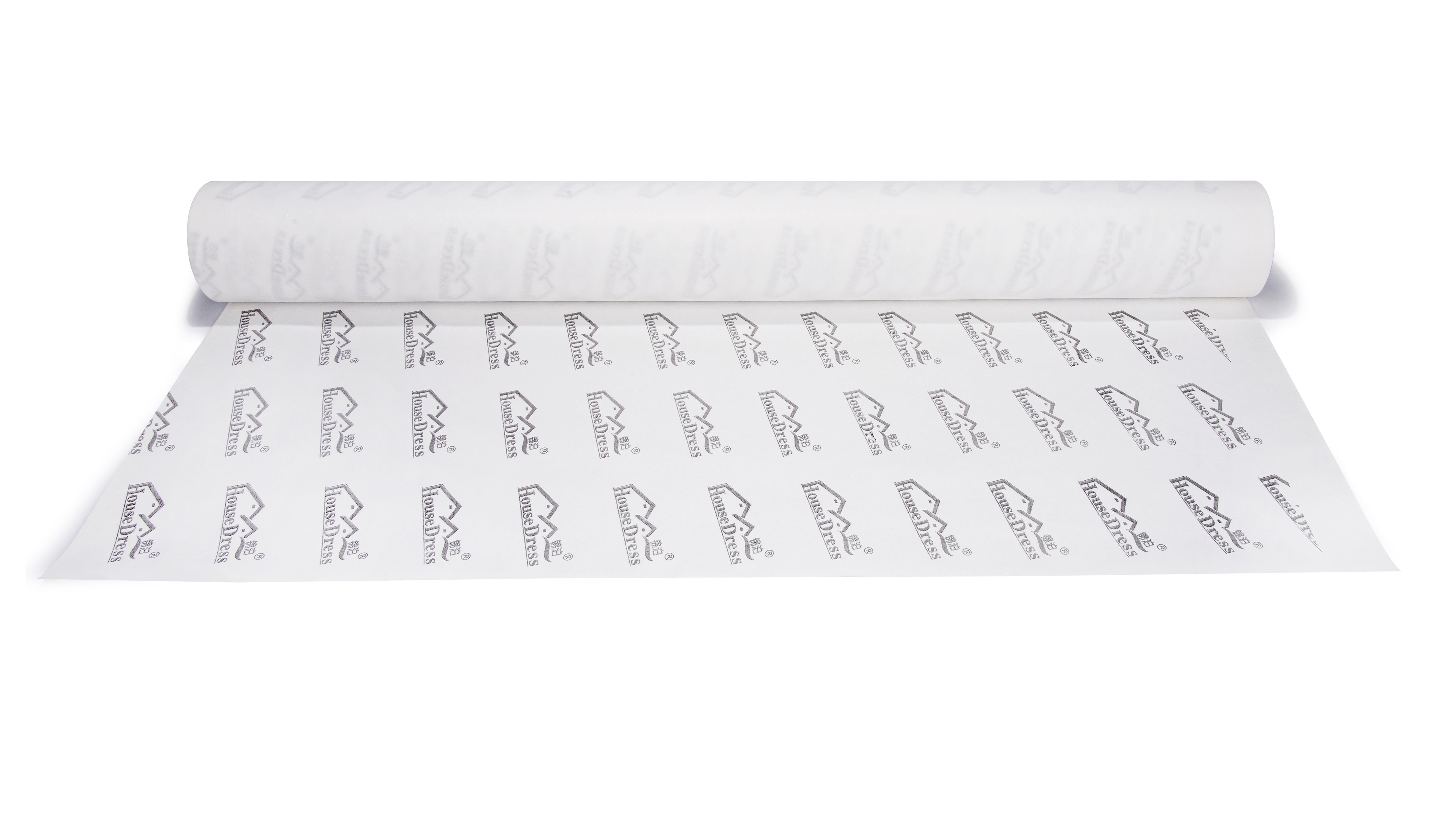
Most breathable membrane data sheets bury the numbers that actually matter under adjectives like "superior" and "high-performance." Start by ignoring the headline claims and checking the test conditions behind the moisture vapor transmission rate. A membrane can look impressive at 38°C and 90% relative humidity, yet perform very differently at cooler temperatures or lower humidity gradients. If the data sheet does not state the test method and conditions next to the number, treat that number as decorative rather than functional.
The second habit is to distill the sheet down to three values: hydrostatic head, air permeability, and MVTR. Hydrostatic head tells you how much water pressure the membrane can resist before leaking; air permeability matters for wind-driven rain and pressure equalization; MVTR indicates how quickly moisture can escape. Compare those values only when the units and test standards align. For example, an MVTR measured by ASTM E96 Method A cannot be directly compared with one from Method B, and a hydrostatic head reported in mm of water is meaningless without the test duration.
Finally, look for the missing pieces: abrasion resistance, UV stability, and compatibility with the adjacent layers. A membrane that passes a clean lab trial may fail after exposure on a jobsite or when pressed against a rough substrate. Ask for the data that is not on the sheet, and if the supplier cannot provide it, that silence is often more informative than any marketing phrase printed in bold.
Where the Factory Draws the Line on Thickness and Tear Strength
In most plants, “thicker” gets treated like a synonym for “stronger,” but the factory floor tells a different story. The line drawn here isn’t based on a single number from a thickness gauge. It comes from watching a film tear at 12 mils while a 9-mil sample holds up because the resin blend and cooling rate were different. So when someone asks for a thicker sheet expecting better tear resistance, the answer often starts with a question: what’s the actual abuse this material will see? The factory’s boundary is set where added thickness stops paying for itself in real tear strength and starts creating stiffness, curling, or waste.
That boundary shows up most clearly on the testing bench, not in a sales brochure. A batch might measure exactly on spec for thickness but fail the Elmendorf tear test by a wide margin. When that happens, it doesn’t ship—regardless of what the purchase order says. The line exists because tear strength tracks the molecular orientation and not just the cross-section. Push a low-quality resin to a higher gauge and you get a thicker sheet that still splits along a weak path. The factory holds that line by rejecting orders that insist on thickness alone without a matching tear requirement, explaining to the customer that nobody wants a heavy tarp that rips like a paper bag.
The line isn’t static, though. It shifts when a new polymer enters the mix or when extrusion temperatures get dialed in differently. What stays fixed is the refusal to pretend that thickness can cover for poor material or rushed processing. Some clients have walked away after hearing that, but most come back once they see the failure videos side by side. The factory’s bottom line on thickness and tear strength is simple: if the numbers can’t back up the claim in a real-world pull, the roll doesn’t leave the dock.
The Testing Room Most Buyers Never Ask About
Most walkthroughs follow the same pattern: buyers test the faucets, flip a few light switches, and peek inside closets. What rarely gets a second glance is the small, unglamorous room tucked near the mechanicals. That room often holds the pressure gauges, water-quality sample points, and airflow monitors that reveal far more about a property than a fresh coat of paint ever will.
A trained inspector can spend twenty minutes in there checking static pressure, looking for crossed connections, and listening to how the ventilation responds under load. These details do not show up in listing photos, yet they often explain why a basement smells damp in July or why one upstairs bedroom never cools evenly.
If the door is locked or the agent waves you past it, ask to see inside anyway. The condition of that space usually mirrors how the rest of the building has been maintained, and it is one of the few places where problems have nowhere to hide.
Why Batch Consistency Depends on the First Ten Minutes
In most mixing or reaction processes, the opening minutes quietly decide what the rest of the batch can become. The initial contact between raw materials, the rate at which heat is applied, and the first stable set point for agitator speed create a base condition that later corrections only partly reshape. If a powder is added too quickly before the liquid reaches the right viscosity, or if the jacket temperature is still recovering from a previous cycle, the batch carries that early unevenness through to the end no matter how carefully the midpoint checks are run.
The reason this window matters so much is that many material changes are path-dependent rather than simply time-dependent. A slow pH adjustment in the first ten minutes may allow different crystal habits or emulsion droplets to form than a fast adjustment would, and those structures do not fully converge later. Operators who track temperature, torque, and feed rate at one-minute intervals during startup can catch drift before it becomes irreversible, tightening batch-to-batch variation at the stage where control is still cheap.
Practical consistency therefore starts with making the first ten minutes boringly repeatable: preheating transfer lines, verifying raw material lots have equilibrated to room conditions, and using a short startup sequence that removes operator guesswork. When that early window is locked down, the rest of the batch has far less noise to fight.
Questions That Separate a Working Plant from a Finished Warehouse
A plant can be running at full tilt and still not behave like a finished warehouse. The difference is usually exposed by practical questions: Can a supervisor walk the floor and spot a problem without opening a dashboard? Does the flow stay stable when one dock door goes down, or does the entire shift quietly fall behind? Is every staging lane owned by someone, or does inventory drift into whatever corner happens to be free? These are not design review questions; they are the checks that reveal whether a facility is merely commissioned or actually settled.
A second dividing line is how the building reacts when the usual experts are not around. A working plant often leans on a few veteran operators who know which scanner misses a torn label and which conveyor hesitates under full load. A finished warehouse turns that knowledge into visible signals: slotting rules, count tolerances, posted exception paths, and a daily rhythm for clearing damaged pallets before they block a pick route. The real test is not a clean run under perfect conditions, but a smooth recovery after a missed sort, a late trailer, or a last-minute order change.
The final set of questions concerns the handoff to routine operation. Does maintenance see the same live signals as the shift lead? Are replenishment triggers driven by actual movement, or still by assumptions from the project plan? Can a new associate learn a task from floor markings and labels, or is training built on unspoken habits? When those questions get specific answers instead of shrugs, the site has stopped being mechanically alive and started being operationally complete.
FAQ
Reliable lines go beyond simple extrusion. They include in-line corona treatment, precise tension control for lamination, and real-time basis weight scanners. These details keep the membrane uniform so breathability and tear strength do not vary from roll to roll. Lines that skip these steps often produce cheaper material but with weak spots and inconsistent moisture vapor transmission.
Most producers use a polypropylene nonwoven or a polyethylene film as the structural layer, then add a microporous film or coating. The exact blend changes the balance between air and moisture permeability, water resistance, and UV stability. Some suppliers use a heavier nonwoven to mask lower film quality, which is why basis weight alone does not tell you everything.
They usually run moisture vapor transmission tests according to ASTM E96 or equivalent standards, alongside hydrostatic head tests for water resistance. A high hydrostatic head with very low vapor transmission means the wrap blocks liquid water but also traps moisture inside the wall, which is a common failure in low-end products.
The most relevant are EN 13859-1 for walls, ASTM E96 for moisture vapor transmission, ASTM D882 or D5034 for tensile strength, and ASTM D5733 for tear resistance. Some factories also test UV exposure separately because house wrap often sits uncovered longer than expected. A supplier should provide batch-level reports rather than a single sample certificate.
Gram weight only measures total mass per square meter, not how the layers are built. A product with a dense coating and thin substrate can weigh the same as one with a strong nonwoven and a well-calendered microporous film, yet tear differently and pass moisture at very different rates. You have to compare the full data sheet, not just the weight.
Better producers lock raw material specifications with suppliers, test incoming resin and nonwoven lots, and keep records by batch number. During production, they check coating weight, roll width, and splice counts. After slitting, they pull samples from the beginning, middle, and end of each master roll so a problem cannot hide in the middle of an order.
There are three main routes: extrusion of a microporous film, lamination of a film to a nonwoven, and coating onto a substrate. Laminated versions often offer better tear strength and handling, while pure film can be lighter but more fragile. The lamination process needs careful adhesive or thermal bonding, otherwise the layers separate after exposure to heat and moisture.
Request retained samples from three recent production batches, a detailed data sheet with test methods, and a clear statement on UV exposure limits. Ask for a video or live inspection of the coating and slitting area, not just the final warehouse. Also ask how the factory handles rejects and whether it labels each roll with a traceable batch code.
Conclusion
A roll of house wrap does not earn a shipping label just because it looks smooth and feels tough. Before it leaves the floor, the line operator checks edge trim, core alignment, and the first few meters for pinholes or stretch marks that later become callbacks. Reading the data sheet without the marketing fog means ignoring the headline vapor permeability number until you know the test method, conditioning time, and whether the lab tested the coated or uncoated side. On thickness and tear strength, a serious plant sets a narrow rejection band: it will hold back a batch that is within nominal weight but soft in cross-direction tear, because that is where wind-driven rain failures start. The testing room most buyers never ask about is usually tucked behind the extrusion hall, with QUV cabinets, cold impact plates, and lap shear fixtures that expose how the membrane behaves after six months on a scaffold, not just on day one.
Batch consistency is rarely a rolling average issue; it is decided in the first ten minutes after startup. Until melt temperature, screw speed, and cooling roll pressure settle, the film can drift between stiff and baggy, so experienced plants either discard the warm-up footage or label it as non-prime instead of mixing it into your container. That small discipline separates a working plant from a finished warehouse. A warehouse can show you a tidy sample room and a stack of certificates; a working plant can tell you the current line speed, the waste rate on your product, which shift ran the last order, and let you watch the start-up strip being cut away. Ask those questions and the inspection becomes less about the building and more about whether the factory actually controls what it ships.
Contact Us
Contact Person: Miranda
Email: [email protected]
Tel/WhatsApp: +8615231299719
Website: https://www.ihousewrap.com/