

High Class Cleanroom Supplier Standards That Define Excellence
2026-09-06
Most cleanroom suppliers can quote a spec sheet. Few can prove their process holds up when it matters. The standards that define a high-class supplier go far beyond ISO badges—they're embedded in how materials are sourced, how documentation is handled, and how a team responds when reality deviates from the drawing. GENO Pharmatech has built its reputation on exactly those hidden details. Here are the supplier standards that genuinely separate true excellence from marketing noise.
Material Traceability That Goes Beyond Paper Certificates
Paper certificates have long been the default proof of material origin, but they carry a hidden cost: a single sheet can be lost, forged, or simply lag months behind the actual movement of goods. When a supplier changes a heat number or blends recycled content without updating the file, the certificate becomes a fiction. Real traceability means watching the material itself, not just trusting a document that was printed weeks ago.
Modern systems attach a unique digital identity to each batch or coil, often via QR codes, RFID tags, or embedded markers that survive processing. As the material moves from mill to fabricator to final assembly, machines and scanners record timestamps, test results, and location data automatically—no manual data entry required. Blockchain-style ledgers can lock these records so that no single party can alter history without leaving a trail, turning the supply chain into an open, auditable timeline.
The payoff is practical, not just theoretical. If a defect surfaces in a finished component, engineers can trace back to the exact pour or extrusion in minutes instead of days, narrowing recalls and protecting margins. Customers also gain confidence when they can scan a part and see its full journey, including recycled content percentages or compliance with conflict-mineral rules. That level of visibility goes far beyond a stamped certificate—it becomes a living record that updates with every handoff.
Why Real-Time Particle Data Changes Cleanroom Supplier Accountability
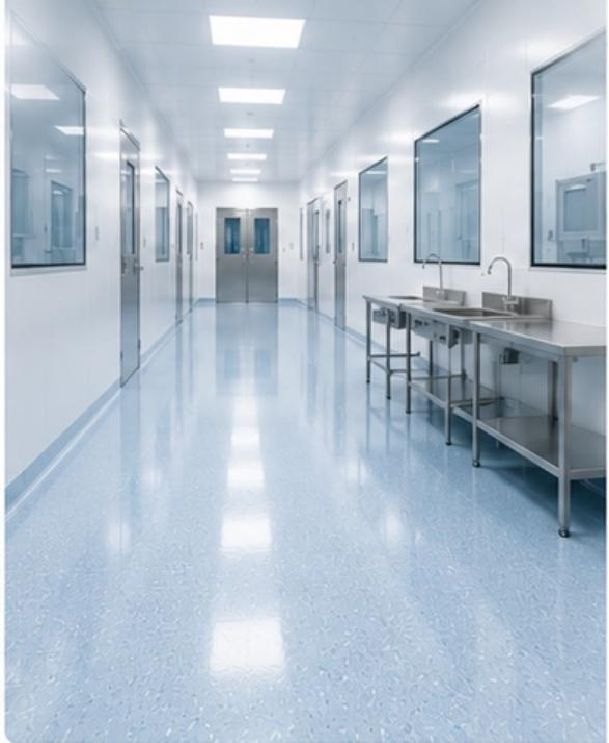
For years, cleanroom suppliers operated behind a curtain. You'd get a certificate of conformance, maybe an audit once a year, and that was about it. Real-time particle data tears that curtain down. Now every spike, every drift in particulate count is logged the moment it happens, with a timestamp and a location. That means a supplier can't point to a clean history from last quarter when yesterday's packaging line showed a 0.5 micron burst. The data doesn't argue.
This shift also changes the nature of the conversation. Instead of asking a supplier "did anything happen last month?" cleanroom managers can open a dashboard and see live counts from incoming materials or remote filling operations. If a batch of stoppers arrives with an elevated particle load, the sensor data from the supplier's cleanroom becomes part of the deviation report. No more finger pointing; the numbers show exactly where the contamination started. That kind of transparency makes accountability a daily operating fact, not an audit-season scramble.
Over time, this leads to stronger contracts and fewer surprises. Suppliers start setting their own internal alerts because they know the customer sees the same feed. Particle thresholds written into service agreements become meaningful, not just boilerplate. The relationship moves from "trust me" to "watch the data with me," which is uncomfortable for some but ultimately rewards suppliers who truly control their environment. Accountability stops being a document you sign and becomes a stream you can't ignore.
The Validation Gap: What High-Class Suppliers Test That Others Skip
When a supplier calls themselves high-class, the difference rarely shows up in glossy brochures or polished sales pitches. It lives in the quiet, unglamorous work of validation testing that most vendors either ignore or rush through. The gap is real: while budget suppliers might run a few basic checks and call it a day, top-tier operations dig into failure modes, edge cases, and long-term stress scenarios that nobody thinks to ask about until something breaks in the field.
Consider thermal cycling on connectors, or accelerated life testing on seals that will sit in a hot engine bay for a decade. High-class suppliers don't stop at the datasheet specs. They push components past rated limits, document exactly where and how they fail, and then redesign before a customer ever sees a prototype. This kind of preemptive torture testing costs time and money, which is precisely why lower-tier shops skip it. But it's also why their parts fail at mile 80,000 while the premium option quietly keeps working.
The validation gap also shows up in software and firmware. A cheap supplier will test happy-path functionality and maybe a handful of error codes. A high-class one builds fault injection rigs, simulates voltage droops and electromagnetic interference, and validates recovery behavior after unexpected resets. They document every test, share the raw data, and invite customers to witness the process. That transparency isn't marketing fluff; it's evidence that the supplier has nothing to hide—and that they've already found the weaknesses before you ever could.
Engineered-to-Order Cleanrooms: When Standard Solutions Undermine Compliance
Standard cleanroom packages often rest on a set of generic assumptions about particle counts, airflow patterns, and personnel movement. Yet real production environments rarely align with those assumptions. A pharmaceutical fill line handling potent compounds, a semiconductor fab managing sub-10-nanometer features, or a medical device assembly area with single-use consumables each impose their own micro-contamination profile. When a catalog cleanroom is forced into that reality, the result is not a compliant space but a convenient approximation. Gaps appear at the interfaces: pass-throughs sized for different containers, ceiling grids that cannot support the required filter density, or return air paths that create dead zones right where operators lean in. Compliance then becomes a retrofit exercise, often more disruptive and costly than starting from the actual process constraints.
The most common failure is not catastrophic but cumulative. A standard cleanroom might meet ISO 14644-1 class limits on paper, yet fail to sustain them under dynamic conditions because the air change rate was balanced for an empty room. Temperature mapping in a vaccine filling suite might show a two-degree drift near a wall that was never designed for the heat load of a labeling machine. In aseptic processing, even subtle pressure cascade reversals during door openings can invalidate an entire batch. Regulatory auditors have seen these patterns repeatedly: cleanrooms that pass initial certification but degrade quickly because the underlying engineering did not account for specific material transfers, cleaning agents, or operator ergonomics. The assumption that one ISO class covers all risks ignores how particle generation, chemical vapors, and microbial dispersion vary from one product to another.
Engineered-to-order cleanrooms approach compliance as a design output, not a verification checkbox. The process starts with the product's failure modes and the operational rhythm of the facility, then builds the room envelope, HVAC strategy, and material flow around those constraints. For example, a cytotoxic compounding pharmacy may require negative pressure relative to adjacent spaces, redundant HEPA filtration in series, and a dedicated pass-through with interlocking doors—none of which appear in a standard modular package. By integrating risk assessment, cleanroom classification, and user requirement specifications early, the resulting space not only meets current regulations but can adapt to future process changes without wholesale reconstruction. This proactive alignment means that validation documents reflect the actual operating state, and deviations become rare events rather than recurring write-ups. In short, when the cleanroom is engineered around the process, compliance is a natural consequence rather than a constant struggle.
The Four-Hour Response Standard: Inside a Supplier's Emergency Protocol
When a production line halts over a defective batch or a sudden raw material shortage, the clock starts before anyone picks up the phone. The four-hour standard isn’t a vague promise tucked into a service-level agreement; it’s a running sequence of three internal gates. First, a dedicated triage inbox tags the incoming issue by part number, impact zone, and whether it can be contained within existing stock. That tag determines which engineer gets pulled off non-critical work, not who happens to be online.
From there, the supplier activates a prewritten communication tree that reaches the client’s shift lead, quality engineer, and logistics contact in parallel. A technician is dispatched or a remote diagnostic session opens within the first ninety minutes. By hour three, a provisional containment plan—often a blend of substitute material approval, rerouted inventory, or rework instructions—is already circulating for sign-off. The final thirty minutes are reserved for documenting what the root cause likely is, what remains unknown, and exactly when the client can expect a follow-up corrective action report. Missing that window triggers an internal review, not a defensive email thread.
Energy Efficiency as a Hidden Indicator of Cleanroom Supplier Maturity
When evaluating cleanroom suppliers, most buyers focus on obvious metrics like particle counts, airflow uniformity, or filter integrity. Yet energy consumption tells a quieter, more revealing story. A supplier that has systematically reduced fan power, optimized chilled water systems, and eliminated wasteful air recirculation has almost certainly mastered the underlying physics and operational discipline required to maintain strict cleanliness. This isn't about green marketing; it's about recognizing that every watt saved reflects a deeper command of air dynamics, thermal loads, and long-term equipment degradation.
Immature suppliers often oversize air handling units, run fans at fixed high speeds, and rely on energy-hungry desiccant dehumidifiers without heat recovery. These practices mask a lack of simulation capability or a fear of non-compliance. In contrast, mature suppliers treat energy as a design variable, not an afterthought. They use variable frequency drives, demand-controlled filtration, and real-time monitoring to match power draw to actual cleanroom class requirements. The result is a facility that breathes efficiently under fluctuating loads, revealing a team that has iterated through countless commissioning cycles and understands where tolerances can be tightened without compromising product safety.
Ask a prospective supplier for their energy intensity per square meter or per cubic meter of clean air delivered. If they hesitate or offer only vague guarantees, that hesitation is a signal. A supplier that can produce trended utility data, explain the rationale behind each pressure cascade and temperature setpoint, and show a continuous improvement curve in specific fan power is one that has matured beyond static compliance checklists. Energy efficiency, then, becomes a proxy for the kind of engineering rigor that prevents costly contamination events down the line.
FAQ
A top-tier supplier obsesses over details like keeping modular wall panel joints within a 1 mm tolerance, using aviation-grade aluminum framing, and delivering a complete particle count verification report with every project rather than just making verbal promises.
ISO 14644-1 and ISO 14644-2 are the baseline, but an excellent supplier also provides third-party FS 209E compliance reports, fire-rated material certifications such as FM 4910, and ready-to-submit EU GMP Annex 1 documentation for pharmaceutical projects.
They avoid standard silicone sealants that can off-gas and instead use low-VOC polyurethane or EPDM gaskets. Wall panels are finished with PVDF coating rather than baked enamel to resist micro-shedding and repeated exposure to harsh disinfectants.
Beyond batch-level incoming material spectroscopy, they perform trial assembly inside a clean environment, use laser interferometry to verify flatness, and link each module's traceability code to the installer's training record. On-site work involves cleanroom-safe tools and tacky mats at every entry point.
Excellence-driven suppliers hand over a working archive rather than a thin manual: material traceability certificates, detailed joint drawings, raw differential pressure test data, and a five-year maintenance plan. This makes audits and future expansions straightforward to execute.
They do not disappear after handover. Instead, they offer up to a three-year warranty on air tightness and cleanliness decay, with free semi-annual on-site checks for HEPA leaks and airflow uniformity. If values fall short, they replace or re-commission the affected areas at no extra cost.
Premium suppliers use demountable and reusable modular structures where walls can be relocated without generating dust, with pre-reserved overhead cabling space and spare penetration points. They also provide dynamic airflow simulation to prove that a revised layout still meets ISO Class 5 unidirectional flow requirements.
Conclusion
Truly high-class cleanroom suppliers no longer treat material traceability as a stack of paper certificates that get filed away. They tie lot numbers to live inventory movements, installation photos, and change logs so that every gasket, filter, and panel can be pinned to a specific date, shift, and operator. This granular chain of custody becomes even more meaningful when paired with real-time particle data streams. Instead of monthly reports, the best suppliers expose differential pressure, temperature, and airborne particle counts on shared dashboards, making deviations visible to the buyer before they become audit findings. That level of transparency quietly separates suppliers who understand contamination control as a continuous state from those who only document it at handover.
The validation gap is where many suppliers fall short: high-class partners test worst-case airflow patterns, recovery rates after door openings, and filter integrity under dynamic occupancy, not just static certification. They also push back against off-the-shelf cleanroom kits when process requirements demand engineered-to-order layouts, because a generic HVAC setup can silently undermine compliance. When something does go wrong, the four-hour response standard is not a marketing line but a rehearsed emergency protocol with local spare parts, on-call technicians, and remote diagnostics already staged. Finally, energy efficiency acts as a hidden maturity marker. A supplier that designs for lower fan energy, smarter dehumidification, and reduced air change waste demonstrates long-term operational thinking, not just bid-day cost cutting.
Contact Us
Contact Person: Amy Yang
Email: [email protected]
Tel/WhatsApp: 008619330882686
Website: https://www.genopharmatech.com/