
ODM Leveling Jack Options That Improve Heavy Equipment Stability
2026-11-16
Heavy equipment stability often comes down to the details most operators overlook until the ground shifts beneath them. From uneven terrain to long-term static loads, the right leveling jack can be the difference between a secure setup and a costly failure. Homall Industry Limited has been refining ODM leveling jack options that address these real-world demands without the usual trade-offs in strength or adjustability. In this post, we’ll break down the design choices and load-bearing features that actually move the needle for stability in demanding job sites.
Uneven ground exposes weak leveling jacks quickly
Most people only notice leveling jacks when they fail, and uneven ground is where that failure happens fastest. A slight slope or a patch of soft soil puts uneven pressure on each jack, forcing the weakest one to carry far more than its rated share. Over time, this overload bends the inner screw, cracks the footpad, or strips the gear teeth. The damage rarely announces itself until you hear a slow creak or see one corner of the machine dip overnight.
The real problem is that jacks are often treated as static supports, but on rough terrain they act more like shock absorbers. Every shift in load, every gust of wind, every footstep on the platform sends tiny vibrations down to the ground contact point. If one jack is already slightly extended or sitting on a hollow spot, those vibrations concentrate there. What starts as a small deflection becomes permanent deformation, and a jack that once held level now leans just enough to make the whole setup unsafe.
Checking the ground first is cheaper than replacing a jack. A few minutes spent filling low spots, adding a wide base plate, or repositioning the unit so all four points rest on similar soil can double the life of the leveling system. If the machine must stay on a slope, use a mechanical lock or an extra stand instead of relying on the jack alone. Weak points don't announce themselves, but uneven ground always finds them.
Screw jacks with locking collars that hold under vibration
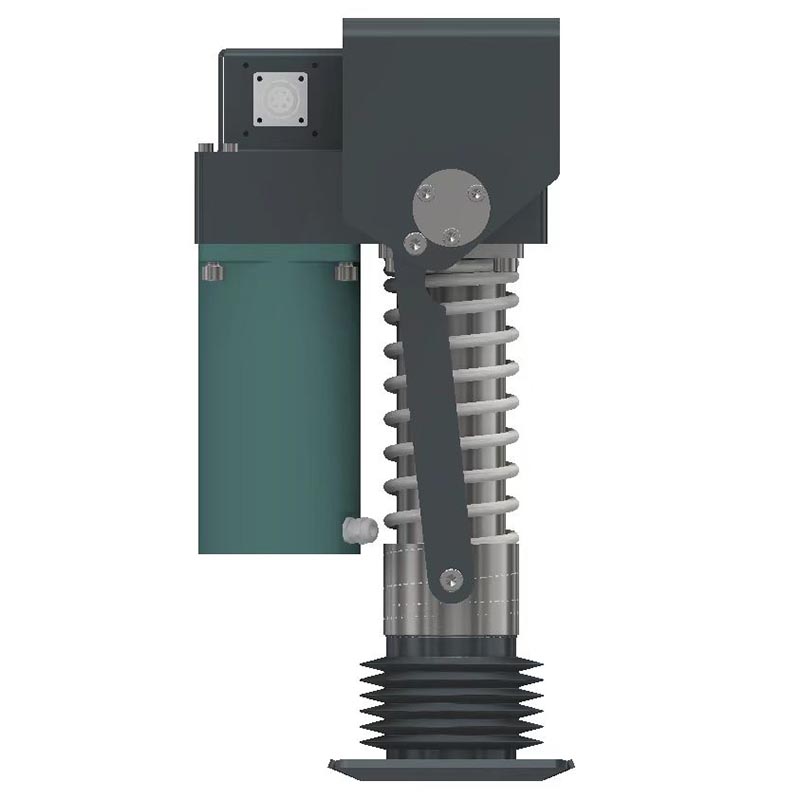
Vibration is the quiet enemy of threaded lifting systems. A standard screw jack may hold its load perfectly on a static test bench, yet loosen and drift after hours of industrial shaking. Locking collars change that behavior. Instead of relying solely on thread friction, the collar clamps against the screw or the worm gear housing, creating a positive mechanical stop that stays put even when the machine rattles.
The real advantage appears in applications where safety margins matter more than convenience. Conveyor lines, vibrating screens, stamping presses, and heavy mixers all generate enough oscillation to back-drive a worm and wheel. A locking collar interrupts that back-drive path, so the load cannot settle or creep downward. Operators can set a height, lock the collar, and walk away knowing the position will still be correct at the end of the shift.
What often gets overlooked is how the collar also protects the internal gearing. Constant micro-movement under vibration accelerates wear on bronze worm gears and leads to premature backlash. By holding the screw rigidly, the collar stops those tiny hammering motions before they chew up the contact surfaces. The result is not just a stable load, but a jack that stays tight and responsive over a much longer service life.
Hydraulic leveling when setup speed cuts downtime
A lot of setup time disappears before the machine ever does real work. With hydraulic leveling, the crew isn't chasing threads or shimming corners; they hit the controls and the pads settle against the floor in seconds. That means the first cut or first lift starts sooner, and the clock isn't burning while someone crawls under the frame with a wrench.
On uneven floors, manual leveling tends to become a back-and-forth routine: check the bubble, adjust, recheck, then tighten everything again. Hydraulic leveling collapses that loop into one action. The system holds position under load, so there's less sag after the first pass and fewer interruptions to re-level between cycles.
Downtime from setup isn't just the minutes spent leveling; it's also the fatigue and guesswork that come with repeating the same procedure. By letting hydraulics handle the heavy part, operators keep a more consistent starting condition and can move to the next job without carrying setup errors forward. It's a small change in the leveling method that shows up as a larger block of available runtime over a shift.
Why a wider base plate keeps heavy loads from sinking
A load doesn’t push into the ground as a single point; it spreads across whatever surface touches the soil. If a narrow plate carries the same weight, all that force concentrates along a small strip, and the ground underneath gives way because the pressure per square inch is high. A wider base plate changes the arithmetic: the same downward force is divided over a much larger footprint, so the ground only has to resist a modest pressure at any one spot.
This is why equipment set up on soft ground, turf, or freshly compacted fill often sits on broad pads or outrigger plates. The wider footprint doesn’t make the equipment lighter; it simply keeps the soil’s bearing capacity from being exceeded. Once the pressure drops below that threshold, the load settles only a little, if at all, and the base plate stays on top of the surface instead of carving into it.
Mounting brackets that stop jacks from walking sideways
A jack that creeps sideways under load turns a simple lift into a guessing game. The right mounting bracket changes that by locking the base into a fixed position, so lateral drift is stopped before it starts. Instead of relying on friction alone, these brackets give the frame a hard mechanical stop that keeps the load line predictable.
On uneven floors or when a vehicle shifts slightly during lifting, sideways movement is often the first sign that the setup is not as stable as it looks. Brackets designed to prevent walking use bolt-down points or flanged edges to resist side pressure. That means less time repositioning the jack and fewer anxious looks at the contact points while the vehicle is in the air.
The practical benefit shows up most in tight workspaces where a wandering jack can put you too close to a wall, a lift post, or another piece of equipment. A solid mounting bracket keeps the tool where you set it, letting you focus on the job rather than correcting the jack's position after every pump.
Custom stroke lengths for equipment that sits low or high
Not every installation sits at a convenient working height. Some units are tucked low under conveyors, while others are mounted high enough that a standard cylinder stroke would force operators to reach or stretch. Custom stroke lengths remove that compromise. The cylinder can be built around the actual vertical or angular travel the equipment needs, so the motion ends exactly where it should instead of overshooting or falling short.
The benefit shows up most clearly during setup and routine maintenance. When a lift or press is positioned unusually low, a shorter stroke prevents the rod from bottoming out or colliding with nearby guarding. When the equipment sits high, a longer stroke can bridge the gap without adding separate risers or awkward linkage extensions. It keeps the mechanism direct and easier to align.
There is no need to rework the surrounding frame just to fit an off-the-shelf dimension. Specifying stroke length as a custom value lets the cylinder match the machine, not the other way around. It also helps reduce wasted motion, component stress, and the kind of small misalignments that turn into premature seal wear over time.
FAQ
Standard models force you to work around their fixed dimensions and mounting patterns. With an ODM approach, the jack can be built around your machine's actual footprint, weight distribution, and ground clearance, so the contact patch and stroke length match how the equipment actually behaves in the field.
Common options include mechanical screw jacks, hydraulic bottle-style jacks, and drop-leg or pin-adjustable designs. Mechanical screw jacks give fine height control and tend to hold position well under static loads, while hydraulic versions handle faster lifting and rough terrain setups. Drop-leg designs are useful when you need a broad height range without pumping a ram through its full travel.
It reduces the amount of frame twist and load shift by providing a fixed, load-bearing contact point that can be adjusted independently at each corner. When one side sits lower, extending the jack on that side keeps the equipment closer to level, which spreads weight more evenly and prevents sudden settling or rocking.
Use the equipment's maximum operating weight, not just its dry weight, and account for attachments, material loads, and dynamic forces when the machine swings or moves. A jack rated too close to the static weight can become the first failure point. A common practice is to leave a 25 to 30 percent safety margin above the worst-case loaded condition.
Yes. If a fleet regularly works on soft ground, larger base plates or swivel feet can be specified to reduce sinking. On rocky or graded surfaces, hardened contact points or articulating pads help maintain grip without bending. The jack's travel length and locking mechanism can also be matched to the slope angles the equipment is expected to encounter.
Rust and contamination are the main concerns. Exposed threads on screw jacks should be cleaned and greased regularly, while hydraulic units need cylinder rod inspections and seal checks. On any design, the locking pins or safety collars need to be free of dirt and checked for deformation. A short inspection after each setup tends to catch problems before a jack slips under load.
A stroke matched to the machine's typical unevenness means the operator does not need to stack blocks or reposition the equipment to make up for limited travel. That can cut positioning time and reduce the temptation to overextend a jack past its safe working range. Custom stroke length also helps avoid carrying multiple jack sizes to cover different sites.
Conclusion
On uneven ground, a leveling jack that cannot hold its position under vibration quickly becomes the weak point of an otherwise stable machine. For ODM applications, screw jacks fitted with locking collars are a practical fix because the collar absorbs the shaking instead of letting the thread creep. When setup time is the bottleneck, hydraulic leveling makes a real difference: the equipment lifts quickly, settles with less manual work, and keeps downtime short. Still, lift force alone does not prevent a corner from sinking. A wider base plate spreads the load over loose soil, gravel, or soft ground, so the jack stays on top of the surface instead of digging in and throwing the whole unit off level.
Stability also depends on keeping the jack exactly where it belongs. Mounting brackets that resist sideways movement stop the unit from walking out of alignment when operators reposition the equipment or when the job site slopes. Because not every machine sits at a common working height, custom stroke lengths allow low-profile equipment to reach the ground without overextending a ram, while taller machines get enough travel to level on rutted or irregular terrain. Choosing those details early in an ODM build means the leveling system reinforces the equipment under load instead of working against it, leaving the operator with a planted, predictable setup.
Contact Us
Contact Person: Ryan
Email: [email protected]
Tel/WhatsApp: +85259582726
Website: https://www.robomast.com/