

Semiconductor Air Compressor Selection: How to Choose the Right One
2026-07-17
Every semiconductor fab knows the pain of a bad air compressor: contamination, downtime, and wasted batches. Choosing the right one isn’t just about specs—it’s about protecting your process from start to finish. With so many options out there, how do you cut through the noise? Seize Air brings clarity to the chaos, helping you match compressor performance to your cleanroom’s real demands. Let’s break down what actually matters before you invest.
Decoding Air Purity Standards for Wafer-Level Protection
At the heart of semiconductor fabrication lies an invisible battleground: the fight against airborne contaminants. For wafer-level protection, even a single particle measuring a fraction of a micron can render a chip useless. That's why air purity isn't just a specification—it's a survival metric. Industry standards like ISO 14644-1 define cleanroom classes by particles per cubic meter, but for advanced nodes, those numbers are only a starting point. The real challenge is achieving and verifying sub-class-1 conditions, where molecular contaminants like amines and organics pose as much risk as particulates.
It's easy to fixate on particle counts, but wafer-level protection demands a broader lens. Airborne Molecular Contamination (AMC) now shares center stage, especially with EUV lithography where even trace levels of ammonia or siloxanes can blur patterns or poison optical surfaces. Standards such as ISO 14644-10 address AMC levels, yet many fabs push beyond those guidelines, targeting low-ppt thresholds. The conversation is shifting from "how clean?" to "how clean is clean enough for the next technology leap?"—and that answer is constantly evolving.
Maintaining such purity isn't a set-and-forget affair. Real-time monitoring systems coupled with predictive analytics are becoming indispensable. Instead of relying on periodic checks, leading-edge fabs deploy a network of sensors that track everything from airborne particle flux to specific outgassing events. This proactive approach turns air quality data into a strategic asset, driving decisions on filter lifecycles, material selection, and even production scheduling. After all, when a billion transistors rest on a pristine silicon canvas, air purity isn't just protection—it's the very foundation of yield.
Why Oil-Free Compression Is a Factory Floor Mandate
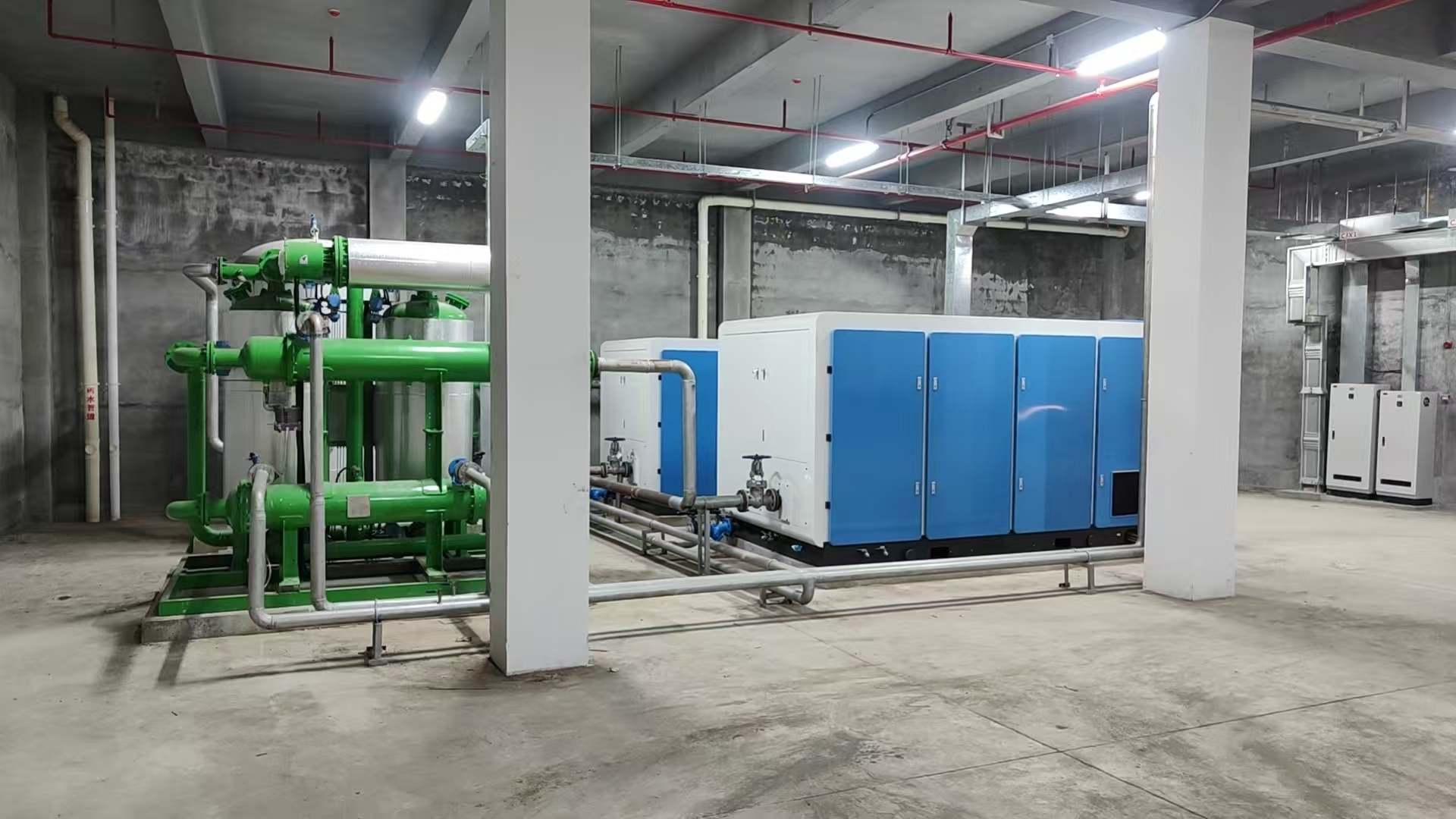
Walking the production floor, you can almost taste the difference. In sensitive manufacturing environments—pharmaceuticals, food packaging, electronics—even a microscopic mist of oil can trigger batch rejections or equipment failures. Shifting to oil-free compression isn't just about cleaner air; it's about removing a latent risk that traditional lubricated systems carry with every cycle. When product purity is non-negotiable, oil-free becomes the only logical path forward.
Maintenance teams feel the burden lift in ways that don't show up on a spec sheet. No more wrestling with oil changes, condensate treatment, or downstream filter replacements that demand constant attention. The real savings hide in plain sight: fewer unplanned stoppages, less labor chasing contaminants, and a simplified supply chain without lubricants and separation elements piling up in storage. It's the kind of operational quiet that keeps lines humming and budgets predictable.
Beyond the obvious contamination concerns, there's an undercurrent of regulatory pressure reshaping industry norms. Audits now scrutinize every contact point between compressed air and final products with a severity that didn't exist a decade ago. Meeting ISO 8573-1 Class 0 isn't a marketing badge—it's increasingly a license to operate. The factory floor mandate has become clear: oil-free compression isn't a premium upgrade; it's the baseline for anyone serious about quality assurance and long-term viability.
Mapping Your Fab’s Actual Load: Avoiding Oversized or Starved Systems
Too often, facility teams base capacity plans on nameplate ratings or peak demand estimates that never materialize in daily operations. A real-load audit reveals the gaps between theoretical maximums and what your tools actually draw cycle by cycle. Without this mapping, you risk pumping excess chilled water, compressed air, or power into zones that sit idle half the shift—or worse, starving a bottleneck tool that peaks when you least expect it.
We start by instrumenting key distribution points with temporary or permanent sensors, capturing minute-by-minute consumption over weeks, not hours. This data exposes patterns invisible to SCADA summaries: simultaneous spikes from batch tools, parasitic loads from idle equipment, and the compounding effect of small leaks across hundreds of fittings. The resulting load profile becomes your blueprint for right-sizing supply modules and storage buffers.
The payoff hits the bottom line twice. First, you avoid capital waste on oversized compressors, chillers, and piping that never run near their design point. Second, you eliminate the micro-stops and quality drift caused by fluctuating process utilities. One fab we worked with found that a 15 percent reduction in N2 supply pressure was all it took to trigger repeated reticle alignment errors—a ghost in the machine that vanished once the actual demand curve dictated the setpoints.
The Real Cost of Moisture and Particulate Contamination
When moisture sneaks into a system, it doesn't just sit quietly—it corrodes metal surfaces, degrades lubricants, and encourages microbial growth. These effects aren't always obvious at first glance, but over time they lead to sluggish performance, erratic valve movements, and gradually increasing energy consumption. The real cost often hides in the premature replacement of components that should have lasted years longer. Replacing a pump or a set of seals may seem like a routine expense, but when you tally up the frequency of failures across a fleet of equipment, the numbers quickly become staggering.
Particulate contamination is equally insidious. Tiny particles act like sandpaper inside precision clearances, accelerating wear on pumps, motors, and bearings. This wear isn't linear—once clearances open up, efficiency drops, and heat generation rises, creating a feedback loop that pushes the system toward catastrophic failure. Beyond mechanical damage, particles can clog filters, orifices, and nozzles, bringing production lines to a halt. The expense here isn't just the replacement part; it's the lost output, the overtime labor to get things running again, and the downstream quality issues that can affect customer satisfaction.
What often goes unnoticed is the compounding effect of moisture and particulates together. Water can cause particles to clump or form sludge, turning a manageable contamination level into a sludge that blocks flow paths and starves components of lubrication. Correcting these problems after the fact typically costs five to ten times more than preventing them with proper filtration and dehydration. The true price of contamination isn't just measured in repair bills—it's the slow erosion of reliability, the unplanned downtime that disrupts delivery schedules, and the creeping sense that equipment is never quite performing at its best.
Reliability Engineering: Features That Keep Pressure Stable Around the Clock
In any system where pressure stability is non-negotiable, reliability engineering embeds layers of defense directly into the hardware and software architecture. Redundant pressure sensors, dual-channel controllers, and fail-safe valves are not mere backups—they’re constantly active, cross-checking readings and ready to take over without a millisecond of hesitation. When a primary component drifts out of spec, the system transitions smoothly to a secondary path, often so seamlessly that operations staff notice only from the event log afterward.
Beyond hardware duplication, modern reliability strategies rely heavily on predictive intelligence. Vibration patterns, temperature shifts, and micro-fluctuations in pressure are continuously streamed to analysis engines that spot anomalies long before they become failures. Self-adjusting algorithms can recalibrate dampening valves, tweak pump speeds, or reroute flow preemptively, keeping pressure within a tight band even as load conditions change. This tight orchestration between sensing, decision-making, and actuation is what makes 24/7 pressure stability a practical achievement rather than an aspiration.
Future-Proofing Pressure: Planning for Node Shrinks and Capacity Hikes
The semiconductor industry operates on relentless cycles of innovation, where each new node demands a complete rethinking of power, performance, and area. But the real tension emerges when you're tasked with designing a chip that must accommodate not just the current process technology, but also the inevitable shrink that'll arrive two years into the product's lifecycle. It's not enough to leave headroom; you need to architect for a completely different set of physical rules—thinner wires, higher resistance, and funky parasitics that can wreck timing closure if ignored. Teams that treat node migration as a simple shrink exercise often discover too late that their meticulously tuned analog blocks refuse to function, or that the digital core suddenly leaks current like a sieve. The pressure isn't just to survive the transition, but to extract a meaningful competitive advantage from it without triggering a full redesign.
Capacity hikes compound this complexity. As markets demand double the throughput at half the latency, floor planning turns into a game of Tetris where the pieces keep changing shape. Adding more cores or expanding cache looks straightforward on a spreadsheet, but physically allocating silicon for future growth without bloating the current die size requires a kind of clairvoyance that most design reviews fail to reward. Smart teams bake in modular interconnect fabrics and reserve routing channels early, even though it feels premature. Others lean too heavily on post-silicon tuning knobs, only to find they've painted themselves into a corner when the next capacity bump hits. The real skill lies in distinguishing between genuine scalability hooks and vaporware—every extra transistor counts, and betting on the wrong expansion strategy means shipping something that's already obsolete before the first customer boots it up.
There's an organizational dimension that often gets overlooked. When the roadmap calls for concurrent node shrink and bandwidth expansion, the natural instinct is to throw more engineers at the problem. But without a clear methodology for tracking assumptions across process variants, you end up with netlist-level confusion that takes months to untangle. The most battle-tested teams don't just plan for shrunken geometries; they enforce rigorous abstraction layers that let analog, digital, and physical design communities explore tradeoffs independently while keeping the global schedule intact. It's tedious, unglamorous work—maintaining golden reference models, stress-testing library corners, and writing cheat sheets for what breaks when you go from finFET to gate-all-around. Yet that discipline is what separates a tapeout panic from a calm migration.
FAQ
In semiconductor fabrication, even microscopic contaminants can ruin chips. The compressed air directly contacts wafers and equipment, so any traces of oil, moisture, or particles will cause defects, lower yields, and costly downtime. Selecting the right compressor ensures ultra-clean, dry, and stable air that meets strict purity standards, which is essential for consistent quality.
Focus on air purity (ISO 8573-1 Class 0 oil-free is typical), pressure dew point (often -40°F/C or lower), flow capacity that matches peak demand plus headroom, energy efficiency since compressors run 24/7, and reliability features like redundancy or remote monitoring. Also think about noise limits, footprint, and compliance with cleanroom standards.
Oil-free compressors eliminate the risk of oil carryover, which is critical because oil vapor can coat sensitive optics, contaminate wafers, and poison cleanroom environments. They use special coatings, water injection, or dry-running designs to deliver pure air without any lubrication contamination. This directly protects your products and reduces maintenance on downstream filters and dryers.
Centrifugal compressors are popular for their high-volume, oil-free output and efficiency at baseload. Oil-free rotary screw compressors are common for variable demand. For ultra-high purity needs, some fabs use oil-free scroll or tooth compressors. The choice often depends on required pressure, flow, and the specific contamination sensitivity of the tools being supplied.
Start by auditing each point of use: photolithography, etching, CMP, etc. Consult your equipment specifications; many require Class 0 oil, Class 1 or 2 particles, and very low dew points. Collect data on particle and moisture sensitivity, then size your air treatment to achieve those targets at the demand peaks. Over-specifying can waste energy, so match the ISO class to actual process needs rather than a blanket 'best possible'.
Treatment is equally important as the compressor itself. Desiccant dryers achieve the extremely low dew points needed to prevent moisture from causing corrosion or short circuits. High-efficiency coalescing and particulate filters remove any remaining particles, and adsorption filters can eliminate oil vapor if not using oil-free compressors. The entire treatment train must be monitored and maintained to avoid breakthroughs that could contaminate the production line.
Conclusion
Semiconductor manufacturing demands compressed air of extraordinary purity, where wafer-level protection hinges on decoding air purity standards that leave zero tolerance for oil vapors or sub-micron particles. Oil-free compression isn't just a preference—it's a factory floor mandate, driven by the unforgiving reality that even trace lubricant can crater chip yields and poison the entire production line. The real cost of moisture and particulate contamination reveals itself in scrapped wafers, corroded tools, and unplanned downtime that erodes profitability. Without rigorous filtration and drying, every wafer is a wager, and the odds tilt against the fab when pure air isn't the rule.
Beyond purity, sizing the system accurately requires mapping your fab's actual load profile—oversized compressors bleed energy and budget, while undersized ones starve critical tools and invite pressure swings that ruin process consistency. Reliability engineering then takes center stage, embedding features like variable-speed drives, redundant arrays, and advanced analytics that keep pressure stable around the clock. And as node shrinks tighten contamination specs and capacity hikes strain infrastructure, future-proofing pressure becomes non-negotiable; a compressor choice made today must flex with tomorrow's processes, scaling gracefully without costly retrofits. It's about weaving purity, reliability, and scalability into a single, strategic decision that underpins yield and throughput from the first wafer to the millionth.
Contact Us
Contact Person: Mia
Email: [email protected]
Tel/WhatsApp: +86 19821985894
Website: https://www.seize-air.com