

Top Shearing Machine Choices for Precision Metal Fabrication
2026-10-20
Precision metal fabrication demands a shearing machine that can hold tight tolerances without slowing you down. Yet with so many models claiming top performance, it’s easy to pick the wrong one. That’s why we’ve put together this rundown of the top shearing machine choices worth your attention this year—including standout options from HUNSONE that blend rugged build quality with repeatable accuracy. If you’re tired of rough cuts and costly rework, keep reading; the right machine is closer than you think.
Blade Materials and Heat Treatment: What Actually Extends Edge Life
Real-world edge retention depends less on marketing names and more on how the steel responds to heat. A blade that's too hard may shatter micro-chips under load; too soft rolls or dulls quickly. The sweet spot is a matrix with fine, evenly distributed carbides and a tempered martensitic structure. For simple high-carbon steels like 1095, a careful heat treatment to around 58-60 HRC can produce a very keen edge, but that edge falls off faster in abrasive cutting than a powder metallurgy steel with well-dispersed vanadium carbides.
Cryogenic treatment often gets oversold, yet it has a measurable effect on certain alloys. By converting retained austenite to martensite and promoting more uniform carbide precipitation after quenching, a proper deep freeze can reduce edge chipping and improve wear resistance by a small but real margin—usually 5-15% for high-alloy steels. The trick is doing it before the final temper, not as an afterthought, and matching the soak time to the steel's specific transformation curve.
Heat treatment rhythm matters more than peak hardness. A rushed austenitizing soak that leaves uneven grain growth or undissolved carbides creates weak points along the edge. Multiple tempering cycles and a controlled quench from the right temperature extend edge life by building a stable, stress-relieved microstructure rather than chasing a number on the Rockwell scale. In practice, a slightly softer blade with a clean matrix often outlasts a harder blade carrying internal micro-cracks.
Swing Beam vs. Guillotine Design: A Practical Comparison for Your Shop
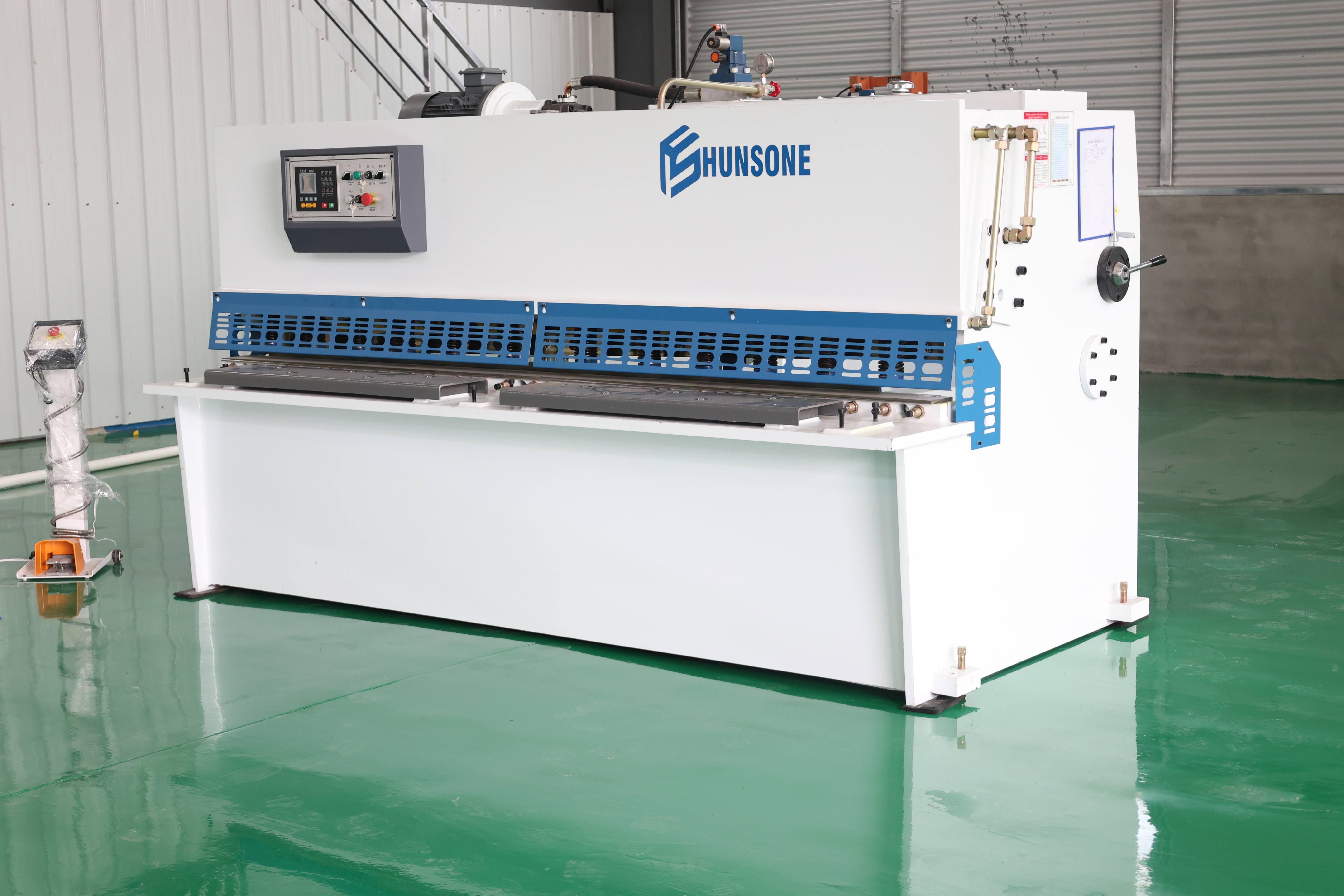
Most shops wrestling with this decision overlook one critical detail: how the blade actually travels. A swing beam shear pivots from a fixed top hinge, so the upper blade arcs through the material rather than coming straight down. This creates a subtle scissoring effect that often produces a cleaner edge on thinner sheet, but it also means the blade gap changes slightly along the cut length. Guillotine shears, by contrast, drive the top blade vertically with gibs on both sides, keeping the rake angle constant from one end of the machine to the other.
That difference shows up in maintenance real quick. Swing beam models usually need blade gap adjustment checked more often because the pivot bearings wear unevenly under heavy use — you might notice the cut drifting off square over time. Guillotine designs hold their geometry better, but the trade-off is that the guide rails demand regular lubrication and occasional scraping if you cut galv or dirty plate. Blade life is another practical point: the swing beam’s rocking motion puts slightly more load on one side of the upper knife, while guillotine blades tend to wear more uniformly across the full width.
For a shop running mostly 16 gauge to 1/4 inch mild steel in shorter lengths, a swing beam usually wins on upfront cost and gets the job done without fuss. If you are shearing long sheets, stainless, or want to hold tight squareness tolerances on thicker plate, the extra rigidity of a guillotine pays off every week. Honest answer: most job shops never outgrow a well-maintained swing beam, but production cutting or precision fab work leans hard toward the guillotine.
Backgauge Accuracy: How Repeatability Impacts Tight Tolerances
When a press brake positions the backgauge, the difference between a good part and a scrap one often comes down to a few thousandths of an inch. Repeatability—the machine's ability to return to the exact same position cycle after cycle—is what separates reliable production from constant adjustment. A backgauge that drifts by even 0.002" on consecutive bends can turn a precise flange into an out-of-spec edge, especially when multiple bends stack up.
Most operators learn this the hard way when they measure a finished part only to find the last bend is short. They check the program, verify the tooling, and then discover the backgauge slipped slightly under load or after thermal expansion. High-quality gauging systems use rigid frames, linear encoders, and servo drives that hold position within microns, not just on paper but under real bending forces and rapid cycling.
Tight tolerances demand more than a one-time calibration. The backgauge must maintain its repeatability across varying sheet thicknesses, bend angles, and ambient temperatures. If you're forming parts for medical devices or aerospace brackets, you need a system that doesn't require constant manual tweaking. Invest in a backgauge with proven repeatability specs, and your setup time shrinks while your first-part yield climbs.
Hydraulic vs. Mechanical Drive: Matching Power to Your Thickest Material
When your thickest material pushes past typical feed limits, hydraulic drives deliver torque without the sudden speed drop common in mechanical setups. A 12-inch slab of hardened steel, for instance, won't stall a hydraulic motor the way it would a gear-driven shaft—the fluid coupling acts like a cushion, letting you maintain steady force even as tooling bites deeper.
Mechanical drives shine in predictable thickness ranges, but they punish you with belt slip and tooth wear once you exceed the designed load. Picture a shear rated for quarter-inch plate suddenly fed half-inch stock: the flywheel stores energy, yet the clutch chatters and the whole frame twists. Hydraulic systems, by contrast, simply ramp up pressure to the cylinder until the cut completes, no shock loading to the transmission.
Matching power means measuring the thinnest and thickest sections you actually process, not just the catalog maximum. If your thickest workpiece is a one-off 50mm titanium billet, a hydraulic drive lets you slow the feed without swapping sheaves or adjusting V-belts mid-run. Mechanical drives can handle heavy stock, but only when you oversize every component—motor, gearbox, and couplings—by at least 40% above the peak torque, which often wipes out the initial cost advantage.
Sheet Support and Material Handling Add-Ons Worth Specifying
Sheet support hardware tends to get cut from quotes when budgets tighten, but anyone who has watched a 10-foot sheet flex during a bend knows the real cost comes later. Front support arms with flip-up stops, side guide rollers, and a sheet follower that moves with the punch keep the material level through the stroke. That level position is what stops flanges from drifting a degree or two off and prevents the operator from having to muscle the sheet back onto the gauge line.
Material handling add-ons are worth specifying at the time of purchase because retrofitting them later almost always means rearranging floor space and reworking ducting or electrical runs. Ball transfer tables, lift carts, and discharge conveyors can be sized to the actual sheet dimensions and part geometry instead of being wedged in afterward. A simple pneumatic scissor lift positioned at the side of the machine often removes more lifting fatigue than any amount of operator training.
For higher-volume shops, an automatic sheet loader or parts unloader stops being a luxury once the cycle time drops below the time it takes to manually sort and stack. Specifying these add-ons from the start ensures the control interface, safety interlocks, and sensor positions are integrated rather than patched together with aftermarket brackets. The savings show up in fewer rejects, faster changeovers, and less dependence on a single strong back.
Total Cost of Ownership: Hidden Expenses You Can Avoid Upfront
Many buyers fixate on the sticker price, but the real drain often shows up later in ways that never made it into the initial quote. Licensing fees that quietly renew, mandatory training sessions, or integration costs with your existing stack can turn a bargain into a budget leak within months.
The trick is to ask vendors for a fully loaded cost breakdown before you sign. Push for line items on maintenance, support tiers, data migration, and even the hourly rate for customization requests. If a supplier hesitates to share those numbers, treat that hesitation as a red flag—not a negotiation tactic.
Upfront savings can be real, but only when you account for the entire lifecycle. Compare three-year totals instead of first-year pricing, and factor in staff time for onboarding and ongoing management. Those hidden expenses don't disappear; they just wait for the next invoice.
FAQ
Focus on blade clearance adjustment, frame rigidity, and a powered back gauge with fine increments. Hydraulic machines often hold tolerances better because the ram speed can be controlled, but a well-built mechanical shear with minimal deflection can also hit tight specs if the blades stay sharp.
Blade gap is everything on stainless. If it's too wide, the material rolls and leaves a burr; too tight and you chip the edge. For 304 stainless around 16 gauge, set the gap about 5-8% of material thickness and test on scrap first. A small tweak of 0.001 inch can change the edge from rough to mirror-clean.
For shops that run both thin aluminum and thick plate, yes. Variable rake lets you lower the angle on thin stock to reduce twist and raise it on thick stock to cut tonnage requirements. Fixed-rake machines are fine if you stick to a narrow material range, but you'll fight distortion when you step outside it.
Check blade clearance weekly, not just when cuts go bad. Keep the back gauge leadscrew clean and calibrated after any jam. Hydraulic oil temperature matters—if the tank runs hot, viscosity drops and the ram can drift, so monitor it on long production runs. And never let dull blades ride; they force the frame to flex and then even new blades won't seat right.
Modern hydraulic shears cycle plenty fast for most shops—15 to 25 strokes per minute on light gauge. They give you full tonnage throughout the stroke, which mechanical shears don't, so you can cut thicker material with a smaller machine. If you're doing 20,000 identical blanks a day, a mechanical shear might edge out in raw speed, but for mixed jobs the hydraulic's adjustability usually wins.
Look for cuts that are square at the top but angled at the bottom, or a bow that gets worse near one end of the blade. A quick test is to cut a 2-inch-wide strip and measure it with calipers at both ends and the middle. If the middle is thinner by more than 0.003 inch, the ram likely has play or the table isn't shimmed level.
It's often the difference between a good shear and a great one. A manual gauge with a vernier scale can hold ±0.010 inch if the operator is careful, but a CNC back gauge with servo drive gets you to ±0.003 inch repeatably and lets you program multi-step jobs. If you run lots with holes or notches, a gauge that retracts before the cut prevents parts from hanging up.
Look for a light curtain that's muting-enabled so it doesn't false trip on material but still stops the blade before fingers can get close. A foot pedal with a two-hand or presence-sensing option keeps operators fast on simple cuts but safe on complex ones. And a clear polycarbonate finger guard that can be swung out for setup beats fixed metal guards that get removed and never reinstalled.
Conclusion
Precision metal fabrication rarely forgives a shear that wanders. The real differentiators hide in details like blade alloys and how they are heat-treated. A blade that holds its edge through thousands of cuts is not just about hardness; it is about the depth and uniformity of the treatment. Pair that with the right frame geometry and you get clean, burr-free edges. Swing beam designs can be easier to maintain and offer a smaller footprint, but guillotine-style machines often deliver a more vertical cut path that reduces twisting on thick plate. For shops chasing tight tolerances, the backgauge repeatability matters more than max stroke length. If it cannot return to the same spot within a few thousandths every cycle, you are fighting the machine instead of relying on it.
Drive type also dictates what you can push through the blades. Hydraulic systems shine on thick, hard materials where steady force matters; mechanical drives can be faster on lighter stock but may struggle when you need consistent power at the bottom of the stroke. Sheet support and material handling add-ons—front arms, stacking systems, scrap conveyors—are not accessories to skip. They change how fast an operator can feed, square, and remove material. Then there is total cost: a cheap shear can hide expenses in blade replacements, hydraulic leaks, or recalibration labor. Spending more upfront on a machine with better blade metallurgy, a rigid guillotine frame, and a repeatable backgauge often costs less per cut over five years. Choose the shear that matches your thickest routine material and your tolerance expectations, not just the brochure's tonnage.
Contact Us
Contact Person: James Chen
Email: [email protected]
Tel/WhatsApp: 86 13770803946
Website: https://www.hunsone.com/