

Ultrasonic Coating System Brands Worth Considering for Precision Applications
2026-09-30
When every micron counts, precision coating isn't just a process—it's a competitive edge. From fuel cells to medical devices, the right ultrasonic coating system can make or break your yields. But with so many suppliers claiming 'nanoscale accuracy,' how do you separate the proven performers from the noise? In this guide, we cut through the clutter and spotlight brands that consistently deliver in demanding applications. Among them, Siansonic has earned attention for its robust engineering and application-specific support. Let's explore the names worth your shortlist.
Why Ultrasonic Coating Is Redefining Precision Application Standards
Ultrasonic coating has quietly shifted from a niche laboratory technique to a cornerstone of high-precision manufacturing. Unlike conventional spray systems that rely on air pressure and suffer from overspray and uneven film build-up, ultrasonic nozzles produce a fine, controlled mist through high-frequency vibration. This allows for deposition layers measured in nanometers, with virtually no waste. The result is a process that meets the tightest tolerances in industries where even a micron of deviation can compromise performance—think medical implants, fuel cells, and advanced electronics.
What sets this approach apart is its ability to handle challenging fluids. Low-viscosity suspensions, shear-sensitive proteins, and conductive inks that would clog standard equipment flow smoothly through an ultrasonic tip. Coating uniformity no longer depends on operator skill or ambient conditions; the acoustic energy atomizes liquid into droplets of remarkably consistent size. That repeatability is critical when coating three-dimensional surfaces, like stents or sensor arrays, where traditional methods leave thin spots or puddling. Manufacturers are discovering that ultrasonic systems dramatically reduce material consumption while improving product yield—a combination that redefines what “precision application” can mean.
The shift toward ultrasonic coating is also driven by sustainability pressures. Because the mist is generated without propellants and can be focused onto the substrate with minimal drift, solvent loss drops sharply. Cleanroom environments stay cleaner, and less energy goes into drying oversized wet layers. Engineers who adopt this technology often report not just tighter specs, but fewer rejected parts and a simpler transition from prototype to full production. In an era where every gram of coating matters and every defect costs money, ultrasonic application sets a new benchmark for precision that older methods simply cannot match.
Key Attributes That Separate Leading Ultrasonic Coating Brands
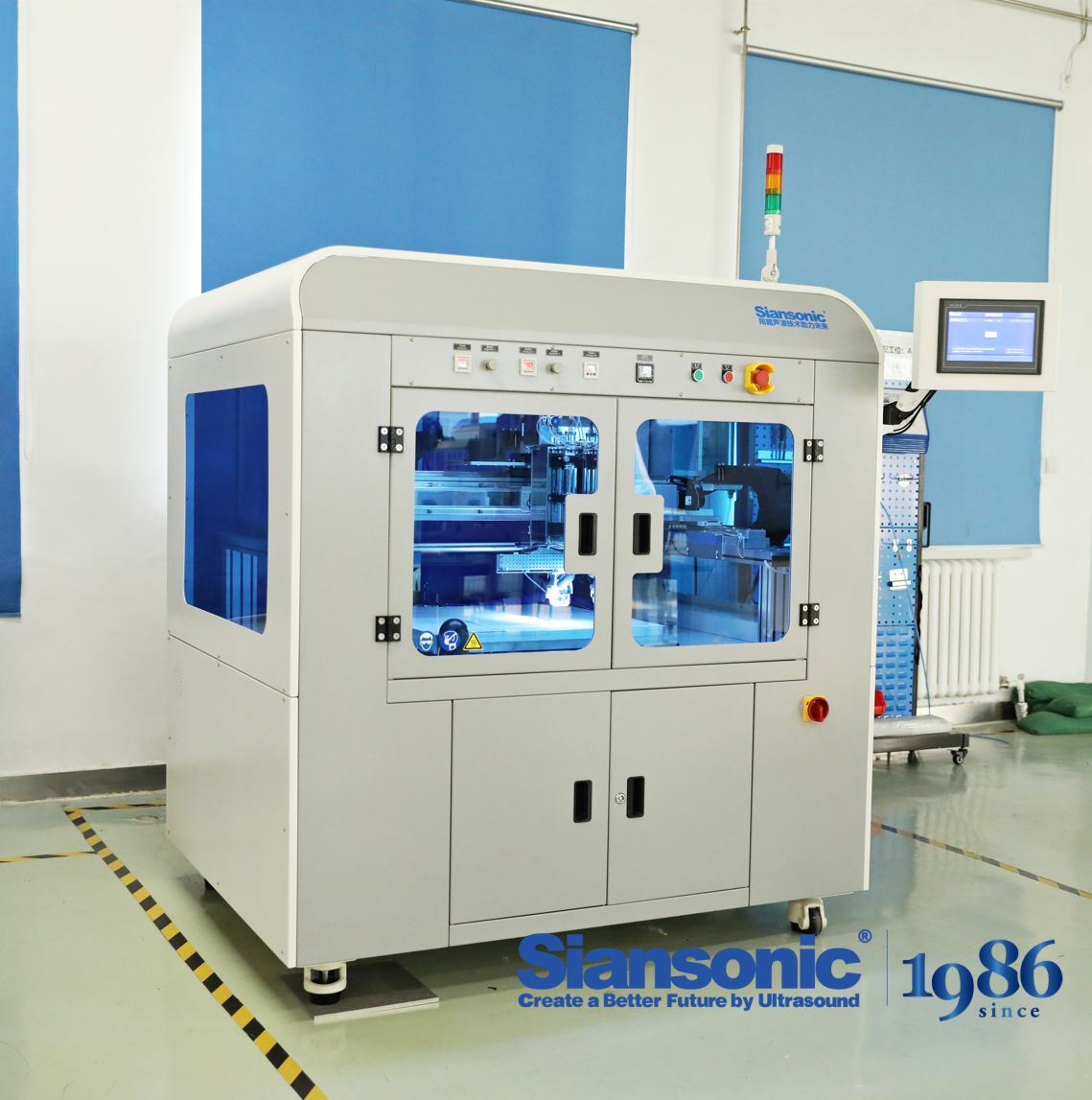
The gap between a good ultrasonic coating system and a genuinely reliable one often comes down to transducer architecture. Leading brands invest in precisely tuned piezoelectric stacks that hold resonance under load instead of drifting as temperature rises. A 2–3 kHz shift can change droplet size distribution enough to ruin edge uniformity on narrow substrates. The best suppliers use active frequency tracking and impedance feedback to keep atomization stable across long runs, while cheaper systems rely on open-loop drivers that start strong but fade after the first few hundred cycles.
Fluid delivery is another separating factor. Top manufacturers pair ultrasonic nozzles with closed-loop, low-pulse syringe or gear pumps that respond to viscosity changes in real time, not just to a pre-set motor speed. A leading brand will let you switch from a low-solids polymer solution to a high-particle slurry without manually re-tuning flow. That level of control prevents bead formation and clogging at the tip, a common failure point in less polished designs.
Serviceability and software transparency add another layer of separation. Instead of hiding behind proprietary black boxes, the strongest brands expose calibration logs, nozzle hours, and maintenance thresholds in an interface that operators actually want to use. They also design quick-release liquid paths and modular nozzles that can be cleaned in minutes, not hours. That might sound mundane, but production uptime is where the real cost difference shows up.
A Closer Look at Nozzle Design and Spray Consistency
The internal geometry of a nozzle rarely gets the attention it deserves, yet it sets the ceiling for spray consistency. A sharp inlet angle or a slightly uneven contraction section can introduce micro-turbulence that follows the liquid all the way to the orifice. What shows up in the field is usually a fan pattern that looks acceptable at first glance but drifts under pressure fluctuations. Even a few microns of variation in the exit edge—often invisible without magnification—will skew droplet distribution toward one side.
Material choice adds another layer. Hardened stainless bodies hold their dimensions longer, but they still erode at the throat where velocity peaks. Ceramic inserts resist that wear better, though they bring their own quirk: thermal expansion differences can alter the effective opening during rapid temperature swings. Operators who track spray consistency over weeks tend to notice the telltale signs early—a heavier center in the pattern, or a gradual increase in drift that no amount of pressure adjustment fully corrects.
In practice, the most reliable way to judge a nozzle is to watch the spray fan itself rather than rely solely on gauge readings. A consistent pattern should show clean, evenly feathered edges and no visible pulsing. When the edges start to look ragged or the fan narrows unexpectedly, it is rarely a pump issue—it is the nozzle telling you its geometry has shifted. Swapping in a fresh nozzle of the same specification often restores uniformity immediately, which underscores just how much of spray consistency lives and dies at the nozzle tip.
How Top Brands Address Thin-Film Uniformity Challenges
Achieving consistent film thickness across large substrates remains one of the hardest problems in advanced manufacturing. Leading brands approach this by combining real-time optical monitoring with closed-loop deposition control, so adjustments happen mid-process rather than after a failed run. Instead of relying on static recipes, they map thickness variation across the entire surface and tune parameters like gas flow, target power, or substrate speed on the fly. This turns uniformity from a post-inspection headache into a continuously managed variable.
Another tactic is deliberate hardware design. Top-tier equipment makers engineer gas distribution plates, magnet arrays, and substrate heating zones to compensate for edge effects and center-to-edge drift. For example, some use multi-zone heaters that independently adjust temperature gradients, while others redesign showerheads to break up precursor flow patterns that cause uneven growth. These aren't one-size-fits-all fixes; they're tailored to specific material systems and substrate geometries, which is why leading brands invest heavily in internal process simulation before locking in a chamber design.
Finally, data-driven uniformity mapping separates market leaders from followers. Rather than sampling a few points and assuming the rest, they use full-wafer or full-panel metrology to build detailed thickness maps. Those maps feed machine learning models that predict where non-uniformity will emerge under slight changes in ambient conditions or target wear. The result is not just better films today, but a feedback loop that makes each subsequent batch slightly more uniform than the last.
Ultrasonic Systems for Medical Device Coatings: What to Look For
When evaluating ultrasonic systems for medical device coatings, focus on how the equipment handles delicate substrates. Many devices—catheters, stents, or implantable sensors—feature thin walls or complex geometries that can be damaged by excessive mechanical vibration. The right system modulates energy delivery in real time, adjusting to changes in load without sacrificing coating uniformity. Look for transducers that operate across a broad frequency range, allowing fine-tuning for low-viscosity hydrophilic coatings as well as thicker drug-eluting layers. A system that simply runs at a fixed setting may work for flat panels but will likely produce uneven coverage on curved or porous surfaces.
One of the most overlooked aspects is nozzle and atomization design. Ultrasonic nozzles create fine droplets through high-frequency oscillation, but the shape and material of the nozzle tip directly influence spray pattern stability. For medical coatings, you need a system that can produce a narrow, focused plume to minimize overspray and waste—especially when working with expensive biologics or antimicrobial agents. Check whether the manufacturer offers custom nozzle configurations and whether the liquid delivery path is fully sealed to prevent contamination. Also, consider how easily the nozzle can be cleaned or replaced between batches; downtime in a cleanroom environment is costly.
Beyond hardware, pay attention to process control and reproducibility. Medical device manufacturing demands rigorous validation, so the ultrasonic system should log critical parameters—frequency, power, flow rate, and atomization pressure—at high sampling rates. Real-time feedback loops that adjust for viscosity drift or temperature changes help maintain coating thickness within tight tolerances. Some systems now include integrated vision inspection or in-line thickness measurement, which can reduce the need for destructive testing. Finally, verify that the equipment can interface with existing automation platforms and complies with cleanroom standards, as retrofitting a system that fights your production line will erase any coating quality gains.
Navigating Brand Claims: Real-World Performance Indicators
When a brand says its jacket can handle a downpour, the only way to know is to stand in the rain. Real-world performance indicators strip away the adjectives and focus on measurable behavior: how long a battery actually lasts under load, whether a waterproof membrane keeps water out after fifty washes, or how quickly a support team responds when something breaks. These numbers rarely appear in ad copy, but they surface in user forums, teardown reports, and independent lab tests.
Another reliable signal is consistency across batches. A single glowing review proves little if the next production run cuts corners. Tracking defect rates, return reasons, and repair frequency over time reveals whether a brand's promises hold up after the hype cycle ends. For example, a laptop line praised for its keyboard might still develop keycap wear within six months—a detail that only becomes visible through aggregated repair logs and long-term owner surveys.
Finally, watch how brands respond when performance falls short. A company that publishes failure rate data, offers no-hassle replacements, and updates its designs based on field feedback is treating claims as a starting point rather than a slogan. That posture—more than any spec sheet—separates products that merely sound good from those that actually deliver.
FAQ
For medical device work, Sono-Tek tends to be the default choice because their nozzles handle low-flow rates consistently, which is critical for drug-eluting stents. Siansonic and Cheersonic also show up often in production lines where users need tight control over coating thickness on small implants.
Sono-Tek has a longer track record with benchtop systems that are easy to dial in for R&D, while Siansonic often provides more aggressive pricing and can customize nozzle geometry for unusual PCB shapes. If you need repeatability across shifts, Sono-Tek's closed-loop liquid delivery usually wins. If you're prototyping and budget matters, Siansonic is worth a close look.
The key difference is droplet size distribution. Ultrasonic nozzles generate a narrow band of droplets without the high-velocity air blast, so you get less overspray and a more uniform thin film on sensor surfaces. That matters when a few microns of thickness drift can throw off sensor response.
Ultrasonic Systems Inc. (USI) often gets overlooked because they focus on industrial-scale systems, but their reciprocating coaters are solid for fuel cell and electrolyzer membranes. If you're moving from lab to pilot production, USI gives you a clear path without having to switch nozzle technology.
You want a system with very low pulsation in the liquid feed, because any pulsation shows up as visible bands on curved lenses. Sonaer and Siansonic both offer syringe-based feeds with stepper motor control that reduce this problem. Also look for a nozzle frequency above 60 kHz if you're applying extremely thin hydrophilic layers.
Usually yes, but you need to verify the nozzle materials. Many systems use titanium horns that are fine for conductive inks but can react with some photoresist solvents. Cheersonic and Sono-Tek offer stainless steel or PTFE-coated fluid paths for solvent resistance, so check those options rather than assuming interchangeability.
Not always. If your coating area is small and you're only doing a few wafers per day, a semi-automated XY stage with manual height adjustment is often enough. Save the full automation budget for when you need to match production parameters exactly, or when repeatability across multiple users becomes a problem.
Hielscher is often cited for integration support because they treat the nozzle as a modular component and provide detailed CAD models and control protocols. Siansonic also has a strong custom integration team, especially for Asian manufacturing sites where local service response matters.
Conclusion
Ultrasonic coating has moved from a niche technique to a go-to solution for manufacturers that refuse to compromise on thin-film control. The real differentiator among brands isn't just the transducer or generator wattage; it's how well the nozzle geometry sustains a stable capillary wave across long production runs. Brands worth shortlisting tend to treat nozzle design as a core discipline, not an afterthought, offering configurations that minimize overspray and maintain droplet size within a tight band. Equally telling is how a system handles viscosity shifts and low-flow start-stop cycles without drifting. When evaluating options for precision work, the most credible names are those that document spray consistency over hours, not just in a five-minute demo.
Thin-film uniformity separates serious contenders from companies selling generic atomizers. Top brands address edge effects and center-heavy deposition through adjustable shaping air, multi-axis motion control, and real-time flow feedback rather than relying on operator guesswork. In medical device coating, that discipline matters even more: biocompatible coatings, drug-eluting layers, and hydrophilic treatments demand repeatable thickness across complex geometries like stents, guidewires, and balloon catheters. Instead of chasing marketing language, look for measurable performance indicators such as coefficient of variation across a batch, nozzle clog resistance, and the ability to hold setpoint flow for weeks. A brand's willingness to share those numbers, along with third-party coating trials, is often a stronger signal than any polished brochure claim.
Contact Us
Contact Person: Ivy Zhang
Email: [email protected]
Tel/WhatsApp: +86 1081502288
Website: https://www.siansonic.com/